
Grok 4.7 vs SuperGrok Heavy: The New Model Is Not the Same Product
Grok 4.7 is a $2 and $6 API model launched 21 Sep 2026. SuperGrok Heavy is a separate $300 consumer tier. Here is which one you are buying.
Grok 4.7 and SuperGrok Heavy share a brand and almost nothing else. One is a text model that launched on 21 September 2026 at $2 per million input tokens and $6 per million output tokens. The other is a consumer subscription, listed around $300 a month, built around Grok 4 Heavy’s multi-agent mode. Buying the subscription does not hand you the new API model, and paying the API does not turn on Heavy’s video allowance. If a launch thread blurred those, this is the correction.
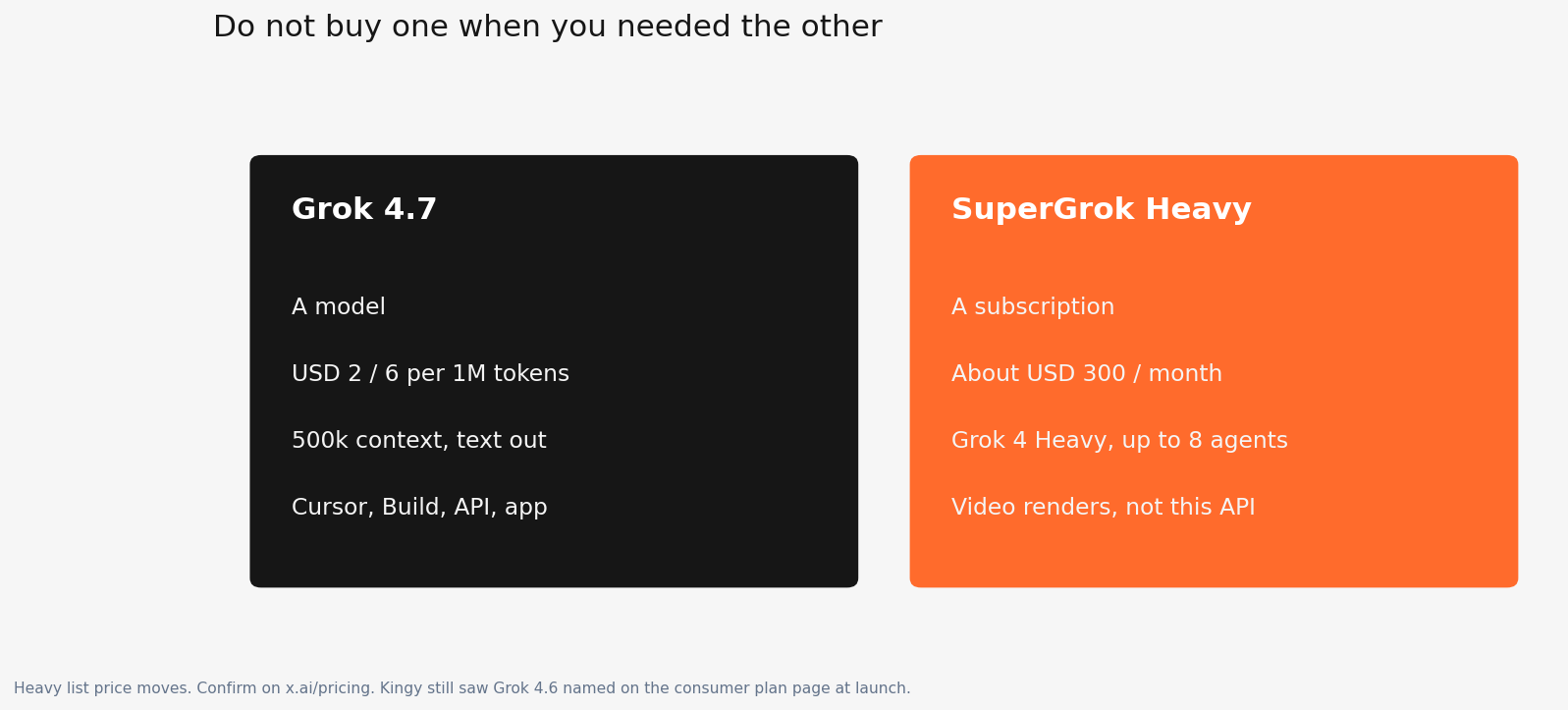
Two products, two bills
| Grok 4.7 | SuperGrok Heavy | |
|---|---|---|
| What it is | A model: API, Cursor, Grok Build, Grok app | A consumer plan above SuperGrok and Plus |
| List price | $2 / $6 per million tokens | About $300 a month, confirm on x.ai/pricing |
| Signature capability | Larger base model, 500,000 token context, self-check on long tasks | Grok 4 Heavy, up to 8 agents, about 500 video renders a day |
| Context | 500,000 tokens, May 2026 cutoff | Heavy’s published window is 256K, some sources say up to 428K |
| Images and video | Reads images, writes text only | Imagine image and video generation live on the plan |
| Confirmed on 21 Sep | Yes, in Cursor, Build, the app, and the API | No. Kingy still saw Grok 4.6 named on the consumer plan page |
Kingy’s launch-day check is the line to remember. The consumer plan page was still naming Grok 4.6. A broad marketing sentence is not proof that web, mobile, or X chat flipped to 4.7. Open the model label in the session you are actually using.
What the new model scored
SpaceXAI compared Grok 4.7 at xHigh effort with Grok 4.6 at High, GPT-5.6 Sol at Max, and Claude Fable 5.1 at Max. DeepSWE for 4.7 is the exception, scored at high effort. It improved on 4.6 in every row OfficeChai transcribed.
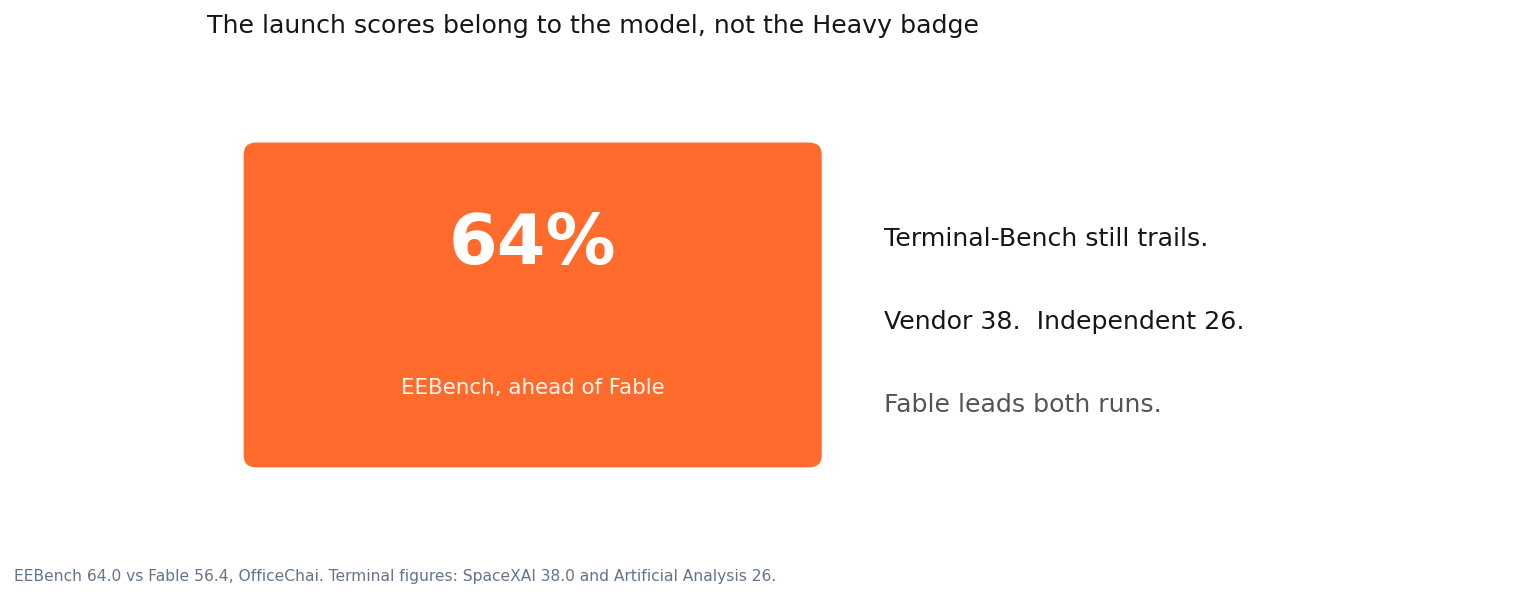
The wins worth keeping: EEBench at 64.0 percent versus Fable’s 56.4 percent and Sol’s 39.4 percent, and a near-doubling on SpaceXAI’s own Terminal-Bench, 38.0 percent versus 20.3 percent for Grok 4.6. The losses worth keeping: Fable still leads CursorBench (51.8 to 46.3), HealthBench Professional (62.1 to 56.7), and that same terminal test by almost 20 points (57.9 to 38.0).
Artificial Analysis is less kind, and you should see both. Its Intelligence Index v4.3.2 puts Grok 4.7 at 46, with Fable 5.1 and GPT-6 at 53. Its Terminal-Bench 4.0 run is 26 percent, not 38, against 55 percent for Fable and 60 percent for GPT-6 Astra. High and xhigh effort tied on the index. I would not pick a subscription tier off either terminal number alone. I would pick it off the fact that both evaluators still rank the frontier Claude and GPT models ahead on agentic coding.
Office work is where 4.7 looks expensive to ignore
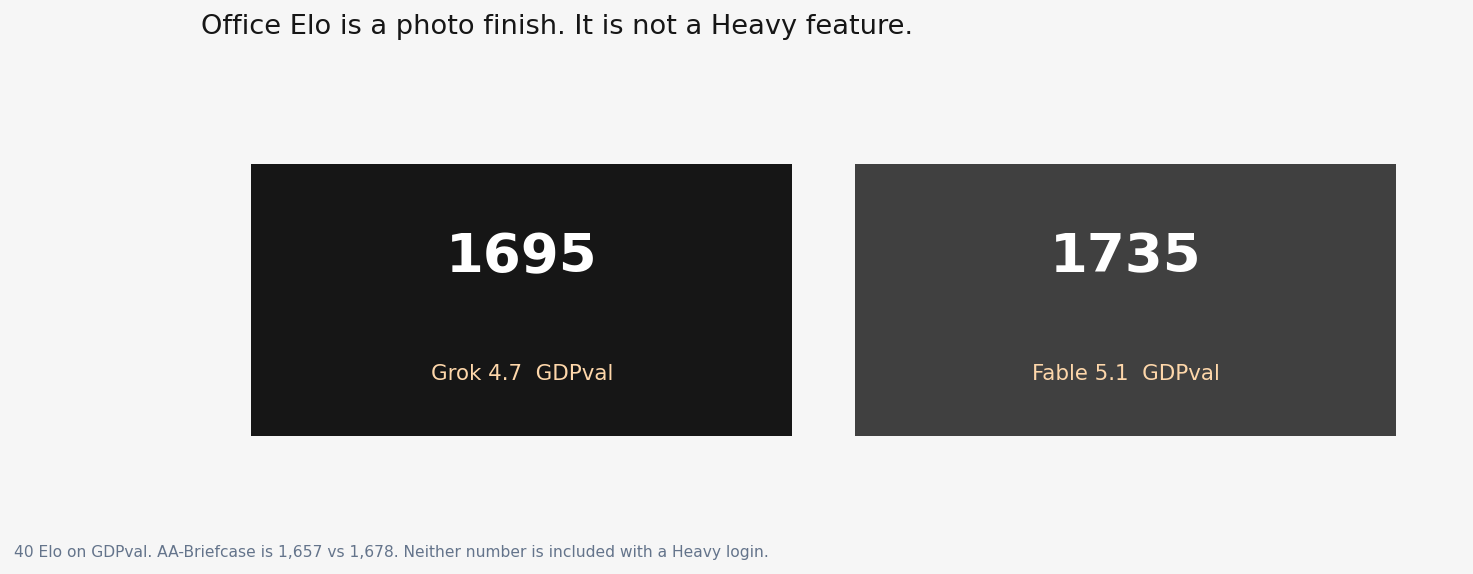
GDPval Elo is 1,695 for Grok 4.7, 1,735 for Fable 5.1, 1,605 for Grok 4.6, and 1,542 for GPT-6 Astra. AA-Briefcase, the multi-hour office task, is 1,657 against Fable’s 1,678. That is a 21-point Elo gap after a 111-point jump over Grok 4.6. For memos, decks, and long briefs, 4.7 is in the conversation with the leading Claude model and nowhere near “a cheap toy model.”
Harvey’s legal-agent score of 19.6 percent beats Fable’s 6.7 percent and Sol’s 2.5 percent. Quote it only with the absolute number attached. Nobody in that table is ready to practice law.
The price chart is the whole strategy
OfficeChai’s reading of the launch prices puts Sol at $4 input and $20 output, and Fable 5.1 at $10 and $50, per million tokens. Grok 4.7 stays at $2 and $6. Fast serving, inside Cursor and Grok Build only, is about twice that for short context ($4 and $12) and is not on the public API. Long prompts of at least 200,000 tokens rebill every token at $4 input and $12 output on the standard card.
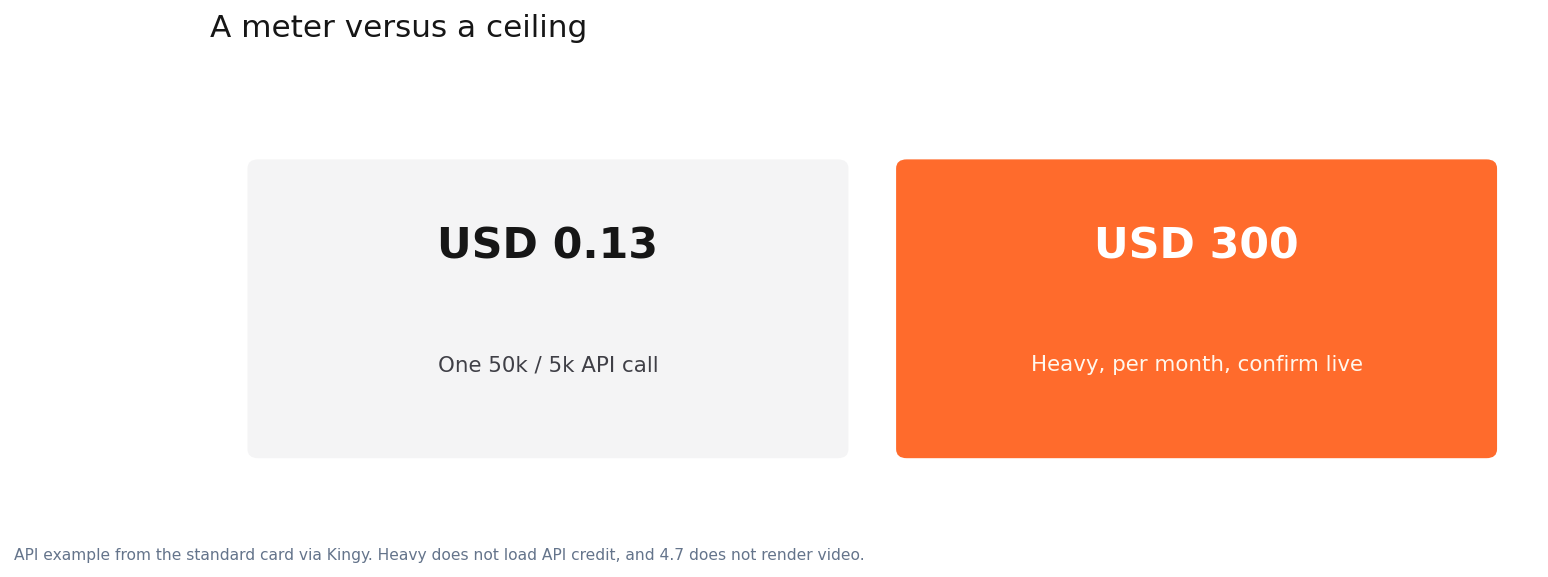
A $300 monthly subscription and a $2 token price answer different fears. The subscription is a ceiling: you stop thinking about tokens until you hit an unpublished chat cap or the video counter. The API is a meter: a 50,000-in, 5,000-out call is about $0.13, and an agent that repeats it ten times is $1.30 before tools. Heavy users of the API can spend more than $300 without ever seeing a plan named Heavy. Light users of Heavy can spend $300 and never touch the model that launched this week.
When Heavy is still the right buy
Keep Heavy in mind for a narrow job. You want Grok 4 Heavy’s multi-agent pass, up to eight collaborating reasoners, on a problem where a single confident wrong answer is expensive. You want the larger weekly usage pool and priority at peak. You want Imagine, on the order of 500 video renders a day, which 4.7 the text model cannot do at all. You want one login instead of an API key and a cost dashboard.
Skip Heavy if the job is code in Cursor, a long document, or anything you can already point at grok-4.7. The 500,000 token window on 4.7 is larger than Heavy’s older 256K figure, the token price is the cheapest serious card in this comparison, and the launch benchmarks above are about this model, not about the subscription badge.
xAI has changed consumer prices more than once in 2026. Before you pay list, read x.ai/pricing and the model name inside the product. If the session still says 4.6, you are not testing 4.7, however new the homepage looks.
A month is enough to tell them apart
Run the same three tasks on both surfaces if you have them: a hardware or EE-style problem, a multi-hour brief, and a terminal chore that has to call tools. Score pass or fail, edits required, and dollars spent. If the text model does the work, stop paying for a video-and-multi-agent plan you are not using. If the multi-agent pass is the thing that actually unsticks the bug, the API model was never the substitute.
For a bounded test of the consumer tier, this site lists a SuperGrok Heavy 1 month plan at $120 against the $300 reference price, with a 3 day warranty. It is an independent activation, not an xAI sale. It does not include API credit, and it is not a promise that the session will show Grok 4.7. Check the label.
Frequently asked questions
Does SuperGrok Heavy include Grok 4.7?
Not as a documented fact on launch day. Grok 4.7 shipped in Cursor, Grok Build, the Grok app, and the API. Kingy checked the consumer plan page and still saw Grok 4.6 named. Look at the model in your session rather than assuming the top subscription moved.
Is Grok 4.7 the same thing as Grok 4 Heavy?
No. Grok 4 Heavy is the multi-agent model associated with the Heavy plan, with up to eight collaborating agents. Grok 4.7 is a newer, larger general model with a 500,000 token window and a public token price. The version numbers sit next to each other and describe different products.
Which is smarter, 4.7 or Fable 5.1?
Fable 5.1 leads the combined Artificial Analysis index, 53 to 46, and leads the vendor coding boards that reward long terminal work. Grok 4.7 leads EEBench in the vendor table and sits 21 Elo behind Fable on AA-Briefcase. Cheaper, close on office work, behind on agentic coding.
Can I use a Heavy subscription as an API key?
No. Consumer subscriptions and the developer API are billed separately. A $300 plan does not load API credit, and API traffic does not draw down the subscription allowance.
What should I confirm before paying?
The live price on x.ai/pricing, the model name in the product, and whether you need video generation. If you need text and code, price grok-4.7 first. If you need multi-agent reasoning plus Imagine, you are shopping for Heavy, and the 4.7 launch does not retire that plan.
Sources
- Decrypt on the 21 September release.
- OfficeChai on the vendor benchmark table.
- The Decoder on Artificial Analysis.
- Kingy on the rate card and the consumer-plan caveat.
- x.ai/pricing for the live subscription price.